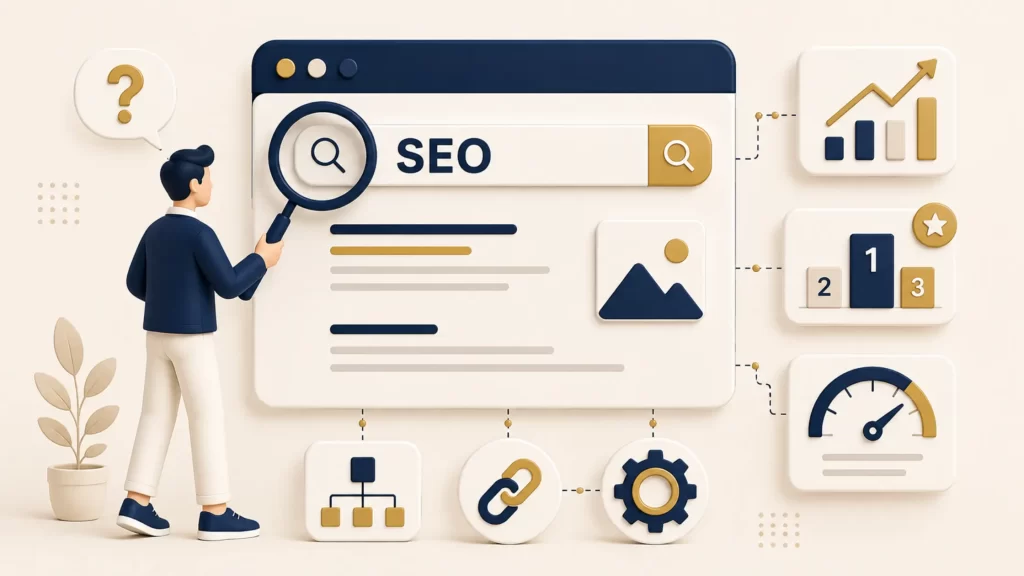
Quick Answer: SEO (Search Engine Optimization) means improving a website so it ranks higher on Google without paying for ads. It works through four parts: on-page content, off-page backlinks, technical site health, and local SEO for “near me” searches. It still matters in 2026 because even AI search tools pull their answers from well-optimized, trustworthy websites.
Every business owner asks the same question eventually: why does one website show up on Google and another doesn’t. The honest answer is SEO, and most explanations of it online make it sound far more complicated than it needs to be.
This guide breaks SEO down the way we explain it to our own students on day one — no jargon, no fluff, just what actually moves a website up the rankings in 2026.

SEO Meaning
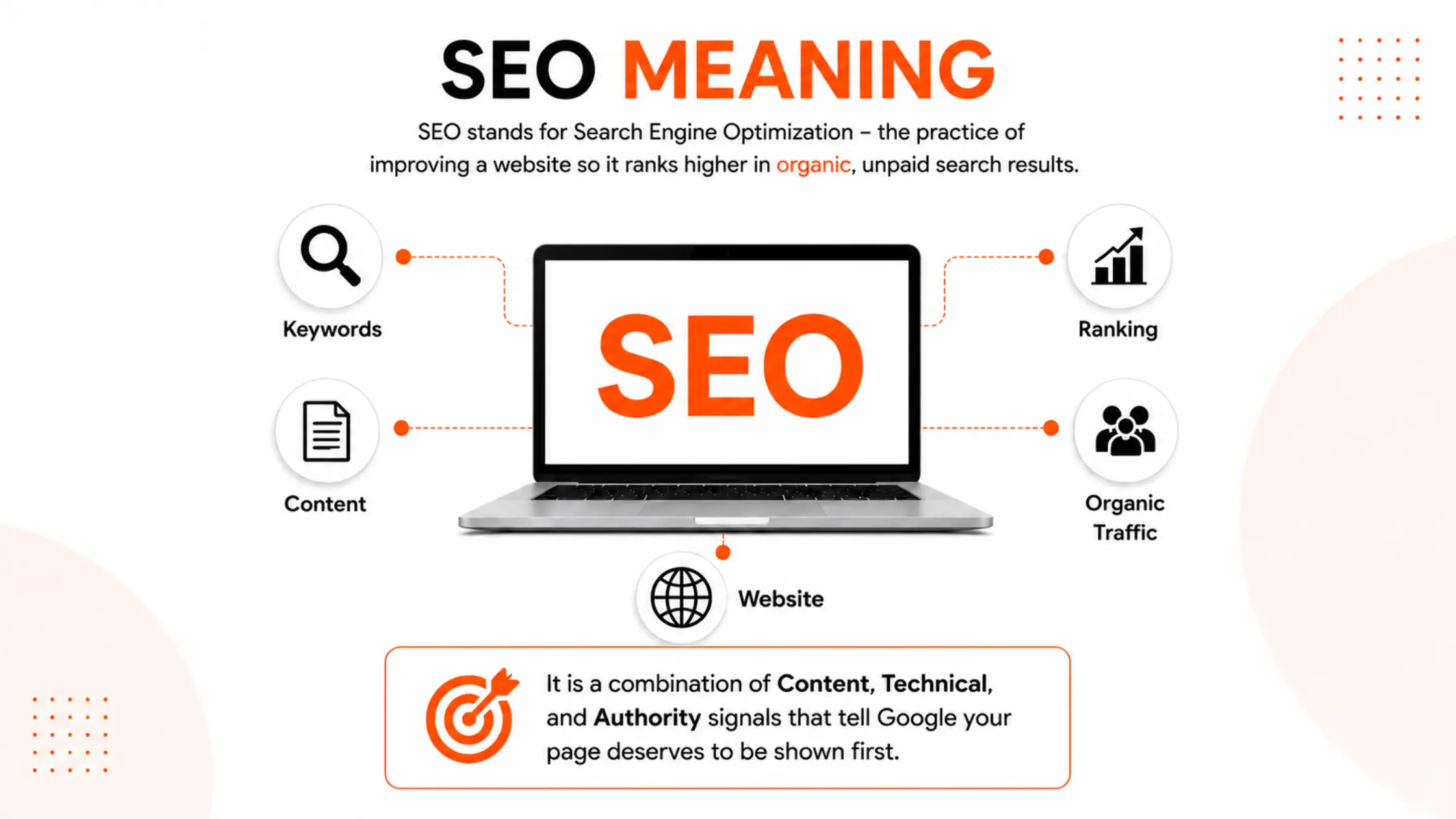
SEO stands for Search Engine Optimization — the practice of improving a website so it ranks higher in organic, unpaid search results.
It is not one trick or one tool. It is a combination of writing, technical fixes, and reputation-building that together tell Google your page deserves to be shown first.
Anyone who promises a “one-step SEO hack” is selling something. Real SEO is a system, not a shortcut.
Search Engines Actually Work
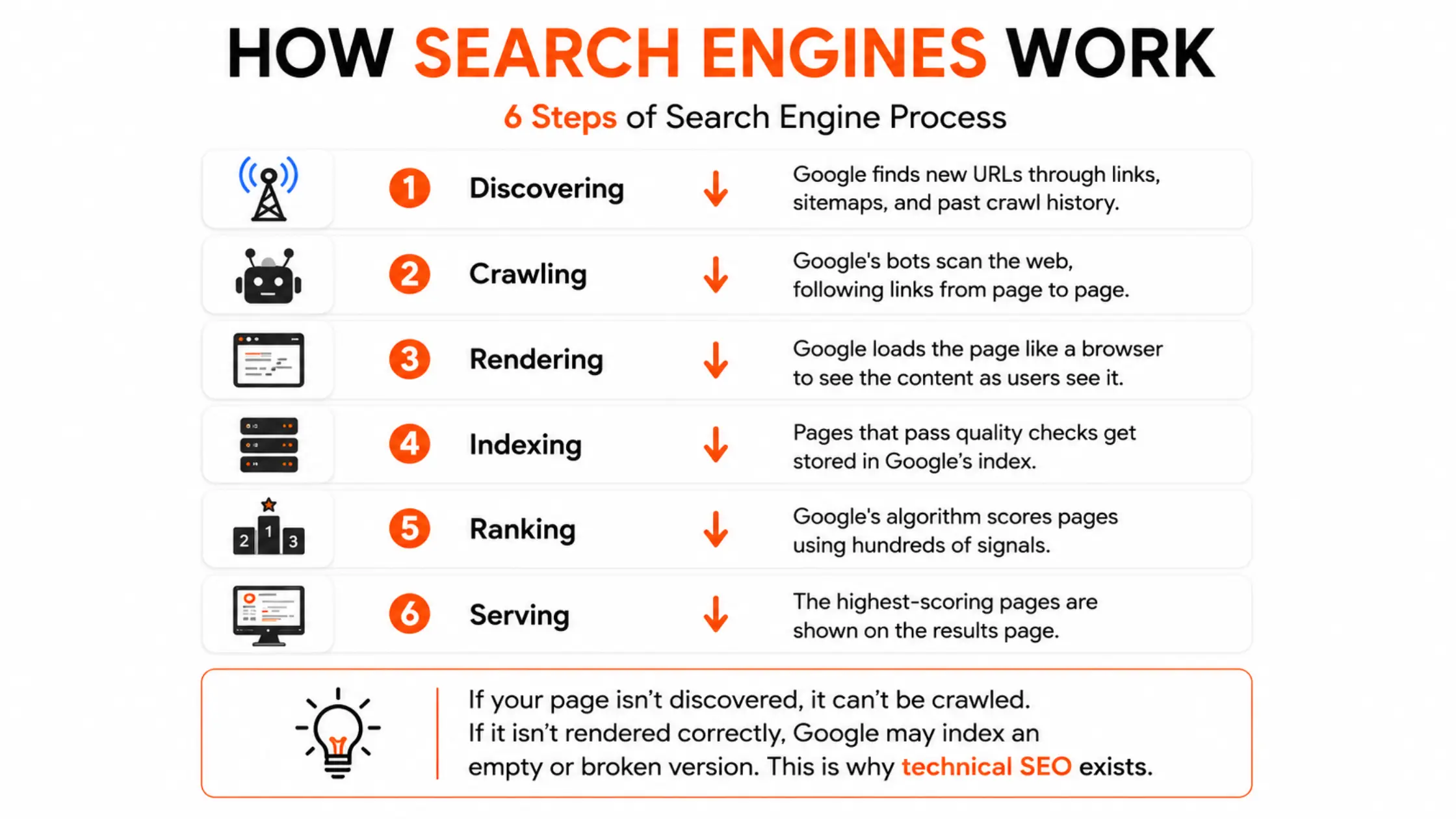
Before you can improve your ranking, you need to understand what Google is actually doing behind the scenes. It happens in six stages, every single time.
- Discovering — Google finds new URLs through links, sitemaps, and past crawl history before it ever visits the page.
- Crawling — Google’s bots scan the web, following links from page to page to fetch new and updated content.
- Rendering — Google loads the page like a browser would, running JavaScript and CSS to see the content as a real visitor sees it.
- Indexing — Pages that pass basic quality checks get stored in Google’s massive database, called the index.
- Ranking — When someone searches, Google’s algorithm scores every relevant indexed page using hundreds of signals.
- Serving — The highest-scoring pages are shown, in order, on the results page.
Note: If your page isn’t discovered, it can’t be crawled. If it isn’t rendered correctly, Google may index an empty or broken version of it. This is why technical SEO exists.
Prefer watching over reading? Watch this video to know what is SEO and How Search Engine Work →
SEO vs SEM vs Paid Ads — What’s the Difference
People confuse these three constantly, and it matters because the strategy for each is completely different.
| SEO | SEM | Paid Ads (PPC) | |
| Traffic type | Organic (free clicks) | Umbrella term for both | Paid clicks only |
| Cost per click | ₹0 | Depends on mix | You pay every click |
| Time to results | 3–6+ months | Immediate (paid side) | Immediate |
| Longevity | Compounds over time | Stops when budget stops | Stops when budget stops |
Note: SEM is simply the umbrella term that includes both SEO and paid search advertising. If someone says “we do SEM,” ask them whether they mean organic, paid, or both — the answer changes everything about the strategy.
The 4 Pillars of SEO
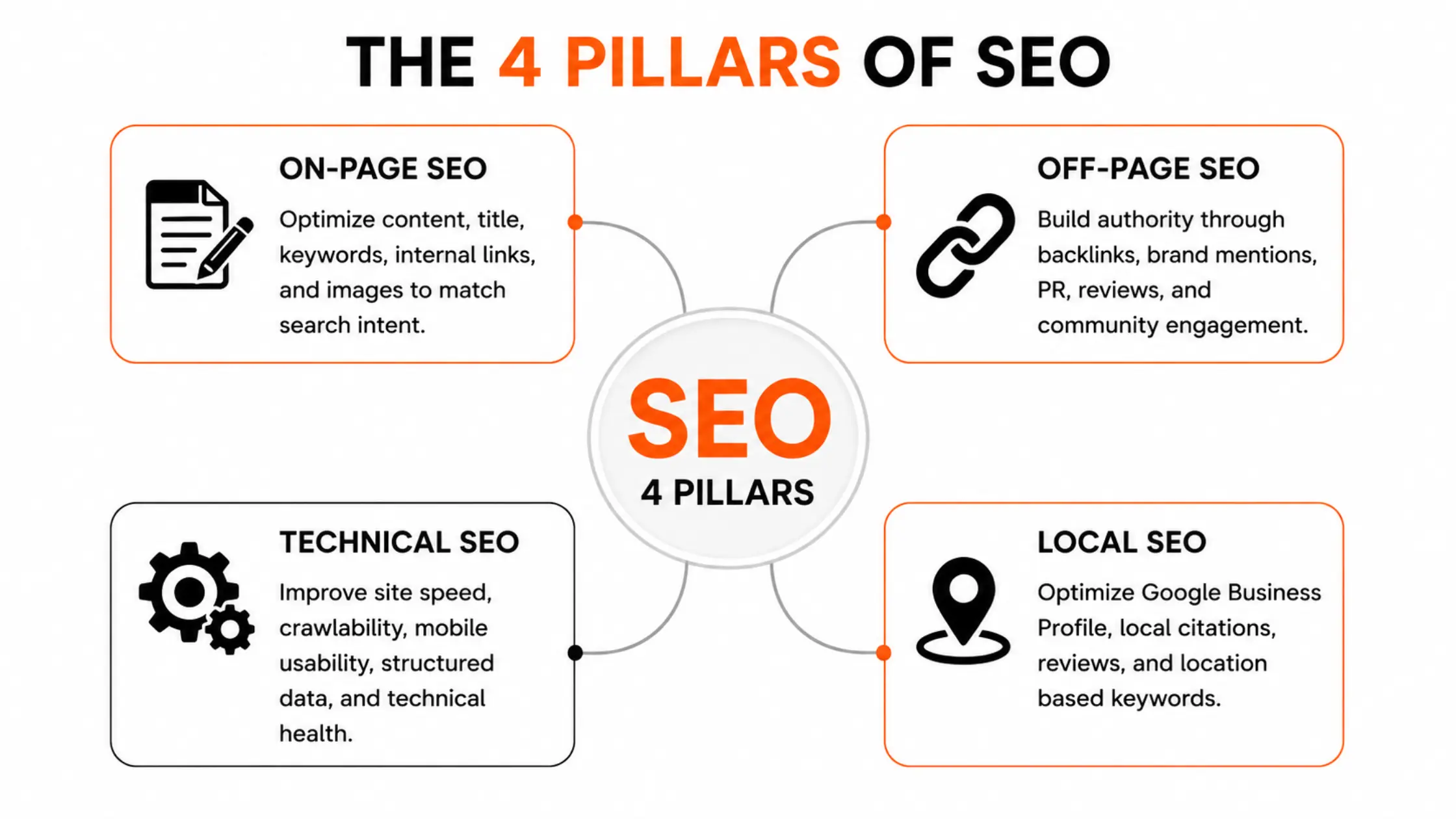
Every ranking factor Google uses falls into one of four buckets. Master these four, and you understand SEO better than most people who claim to be experts.
On-Page SEO
On-page SEO is everything you control directly on your own website — content, titles, description, headings, images, external linking, and internal links.
This is where search intent gets matched. If someone searches “best Online SEO course in India” and your page talks generically about SEO with no local relevance, you lose regardless of how well-written it is.
Good on-page SEO answers the exact question the searcher typed, in the first few lines, then goes deeper.
Here are the major on-page SEO elements you need to get right. Each one plays a different role in helping Google understand and trust your page.
Key on-page SEO elements:
- Title tags and meta descriptions
- Header structure (H1, H2, H3)
- Keyword placement and search intent match
- Content quality, depth, and originality
- Internal linking between related pages
- Image alt text and file optimization
- URL structure
- Content freshness and readability
Off-Page SEO
Off-page SEO is the reputation-building work that happens away from your website — mainly backlinks, brand mentions, and digital PR.
Think of it as word-of-mouth for search engines. When other credible websites link to yours, Google treats it as a vote of trust.
One link from a respected industry site is worth more than fifty links from low-quality directories. Quality beats quantity every time here.
Here are the major off-page SEO elements that build your site’s authority. Together, they signal to Google that other credible sources trust and vouch for you.
Key off-page SEO elements:
- Backlink building (guest posts, digital PR, outreach)
- Brand mentions across the web
- Social signals and shares
- Influencer and creator collaborations
- Online reviews and reputation management
- Forum and community engagement (Quora, Reddit)
- Local citations and directory listings
Technical SEO
Technical SEO covers the backend health of your site — page speed, mobile-friendliness, crawlability, and structured data.
You can write the best content in the world, but if your site takes eight seconds to load, most visitors leave before it even renders.
This is the layer beginners skip and the layer that quietly kills more rankings than bad content does.
Here are the major technical SEO elements that keep your site healthy behind the scenes. Get these wrong, and even great content struggles to rank.
Key technical SEO elements:
- Page speed and Core Web Vitals
- Mobile-friendliness and responsive design
- Crawlability and XML sitemaps
- Site architecture and URL structure
- HTTPS/SSL security
- Structured data (schema markup)
- Canonical tags and duplicate content control
- Broken links and redirect management
Local SEO
Local SEO is the practice of optimizing your business to appear in “near me” searches and Google Maps results.
For any business with a physical location or a service area, this often drives more revenue than national rankings ever will.
Google Business Profile optimization, local reviews, and location-specific content are the three levers that matter most here.
Here are the major local SEO elements that help nearby customers find you first. These matter most for any business with a physical location or service area.
Key local SEO elements:
- Google Business Profile setup and optimization
- NAP consistency (Name, Address, Phone across the web)
- Local keyword targeting (city/area-specific)
- Customer reviews and ratings management
- Local backlinks and citations
- Google Maps optimization
- Location-specific landing pages
Note: This is exactly what our curriculum covers, module by module: On-Page, Off-Page, Technical, and Local SEO, taught using our own live client accounts, not dummy websites.
Why SEO Matters in 2026
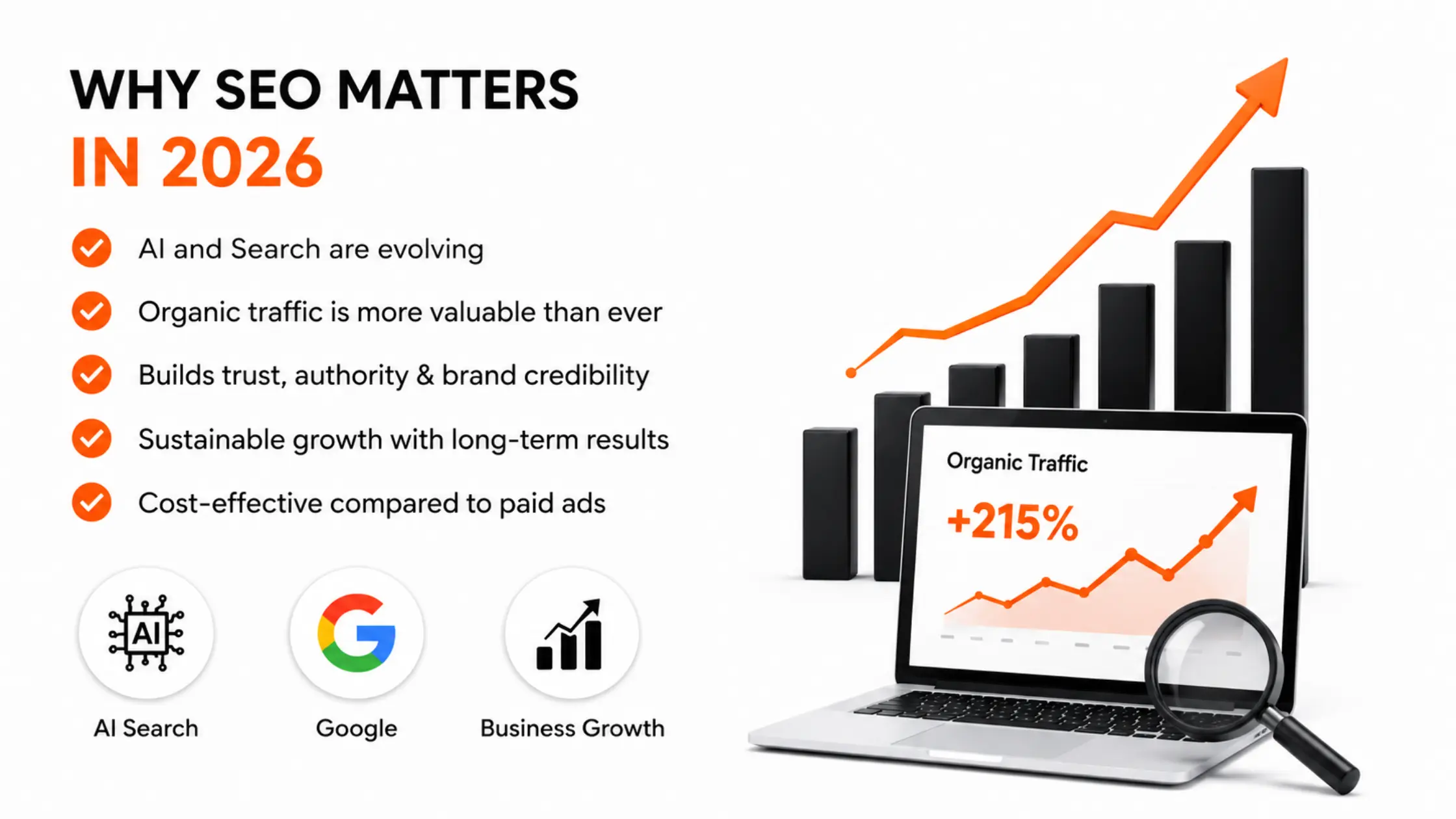
Paid ads stop the moment your budget runs out. SEO keeps sending traffic long after you’ve stopped actively working on a page — that compounding effect is what makes it different from every other marketing channel.
Search behavior has also shifted. Buyers research extensively before they ever contact a business, and most of that research still starts with a search bar, even when AI tools are involved.
A business without organic visibility is invisible during that entire research phase, no matter how good its product actually is.
Is SEO Dead Because of AI Search in 2026?
No — but it has changed shape, and anyone telling you SEO is finished either doesn’t understand AI search or is trying to sell you something else instead.
Google’s AI Mode and AI Overviews don’t skip SEO fundamentals — they run on top of them. Every AI-generated answer is still built from indexed, ranked, crawlable web pages underneath.
What has changed is that AI systems now break one search into many smaller sub-questions before answering, then cite the sources that answer each part clearly. Pages written with structure, direct answers, and real expertise get cited more often — vague, keyword-stuffed pages get skipped entirely.
In short: SEO fundamentals matter more now, not less, because the bar for “good enough to be cited” has gone up.
SEO vs Social Media vs Google Ads — Which Should You Learn First?
This is the question we get most from students who are choosing a digital marketing specialization, and the honest answer depends on your timeline.
| SEO | Social Media Marketing | Google Ads | |
| Best for | Long-term, compounding traffic | Brand awareness & engagement | Immediate leads/sales |
| Learning curve | Moderate to steep | Easier to start | Moderate |
| Results timeline | Months | Weeks | Days |
| Career demand (India) | High, growing | High | High |
If you need income fast, start with Google Ads or freelancing in social media management. If you’re building long-term expertise and career depth, SEO has the steepest learning curve but the strongest long-term payoff.
Most working professionals eventually learn all three — they’re complementary skills, not competing ones.
How Long Does SEO Take to Show Results?
Most businesses start seeing measurable movement in three to six months, with meaningful results typically compounding between six and twelve months.
Highly competitive keywords in crowded industries can take longer. Local and niche keywords often move faster.
Anyone promising first-page rankings in two weeks is either targeting keywords nobody searches for, or setting you up for a Google penalty later.
Is SEO a Good Career in 2026?
Yes — demand for skilled SEO professionals in India continues to rise as more businesses shift budgets from print and outdoor advertising toward digital channels.
The catch is that “SEO knowledge” and “SEO skill” are different things. Reading about SEO teaches you vocabulary; running real campaigns on live websites teaches you judgment.
If you’re serious about this as a career, prioritize training that includes hands-on work on actual client accounts, not just recorded lectures and slide decks.
Ready to Actually Learn SEO — Not Just Read About It?

RankON Technologies Academy trains students on real, live client SEO campaigns — not recycled case studies or dummy websites. Here’s every way to take the next step, pick whichever fits where you are right now:
Get in touch with our team for a free career counselling session and personalized guidance. Call us at 091297 94918 or email us at hello@rankontechnologies.com. We’re here to help you choose the right course and answer all your questions.
Frequently Asked Questions On What is SEO Beginners Guide
What does SEO stand for?
SEO stands for Search Engine Optimization — the process of improving a website to rank higher in unpaid, organic search results.
Is SEO free to learn?
Yes, free resources exist (Google Search Central, YouTube, SEO blogs), but structured, hands-on training with live projects typically speeds up the learning curve significantly.
Can I learn SEO in one month?
You can learn the fundamentals in a month, but real proficiency — the kind that gets you hired or gets client results — usually takes three to six months of consistent, hands-on practice.
Do I need to know coding to learn SEO?
No. Basic HTML awareness helps with technical SEO, but you don’t need to write code to be an effective SEO professional.
Is SEO dead because of ChatGPT and AI search?
No. AI search tools are built on top of indexed, crawlable web content — SEO fundamentals now matter more, not less, because AI systems are more selective about what they cite.
How much does an SEO course cost in India?
Course fees in India range widely, from free self-paced options to premium agency-led programs priced between roughly ₹20,000 and ₹50,000+, depending on depth, live-project access, and mentorship.